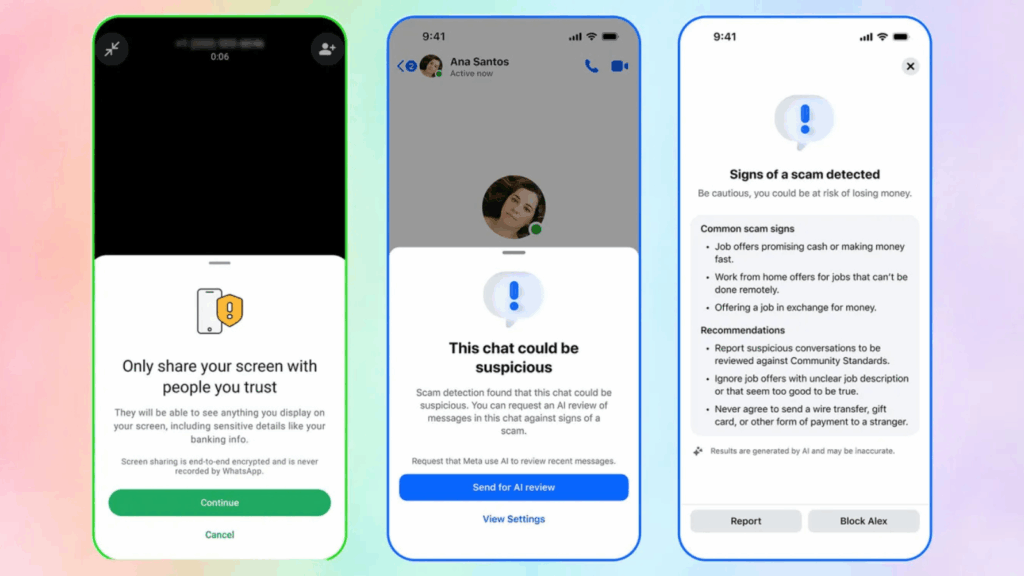
Meta has announced a new set of security tools aimed at strengthening protection for WhatsApp and Messenger users against online scams.
According to Meta, these new updates are designed to help users identify and prevent fraudulent attempts that target personal data, financial information, and digital identities.
Screen-Sharing Warnings on WhatsApp
WhatsApp is rolling out new security alerts that will warn users when they try to share their screen during a video call with someone who is not in their contacts.
This feature is meant to prevent users from accidentally exposing sensitive data, such as banking credentials or verification codes, to potential scammers.
Scam Detection Feature on Messenger
On Messenger, a new “Scam Detection” setting is being introduced under Privacy & Safety options. When enabled, the system automatically alerts users if they receive a suspicious message from an unknown person that may resemble a scam attempt.
“Because detection happens on your device, chats with end-to-end encryption remain secure. If you’re notified that a chat may contain scam signs, you can choose to send the recent messages for AI review. Messages shared with AI will no longer be end-to-end encrypted.”
If the AI system confirms the message as a possible scam, the user will receive educational details about common frauds—such as fake job offers, fast-cash schemes, or unrealistic remote work opportunities. Messenger will then provide quick options to block or report the suspicious account.
Meta’s Wider Anti-Scam Operations
Meta’s broader anti-fraud initiative continues to target deceptive online actors. The company recently took down over 21,000 Facebook pages and fake support accounts that were posing as official representatives to steal users’ personal information.
Additionally, since the beginning of the year, Meta has identified and removed nearly 8 million accounts across Facebook and Instagram linked to organized scam networks operating from Myanmar, Laos, Cambodia, the UAE, and the Philippines. These groups primarily exploit users through messaging apps, dating platforms, and cryptocurrency frauds.
The Rise of “Romance Baiting” Scams
Many of these scams are part of the “romance baiting” or “pig butchering” schemes, in which criminal groups manipulate victims into investing large sums in fake cryptocurrency platforms.
Reports indicate that some of the scammers themselves are victims of human trafficking, lured by false job offers and later forced to participate in these operations.
Once emotional trust is established, the criminals convince victims to invest in fraudulent platforms promising high returns. Eventually, the scammers disappear with the funds, leaving victims with severe financial losses.
Cybersecurity firm Infoblox highlighted in a recent report that these scams rely heavily on psychological manipulation, building emotional connections and false romantic relationships to exploit victims’ trust.

