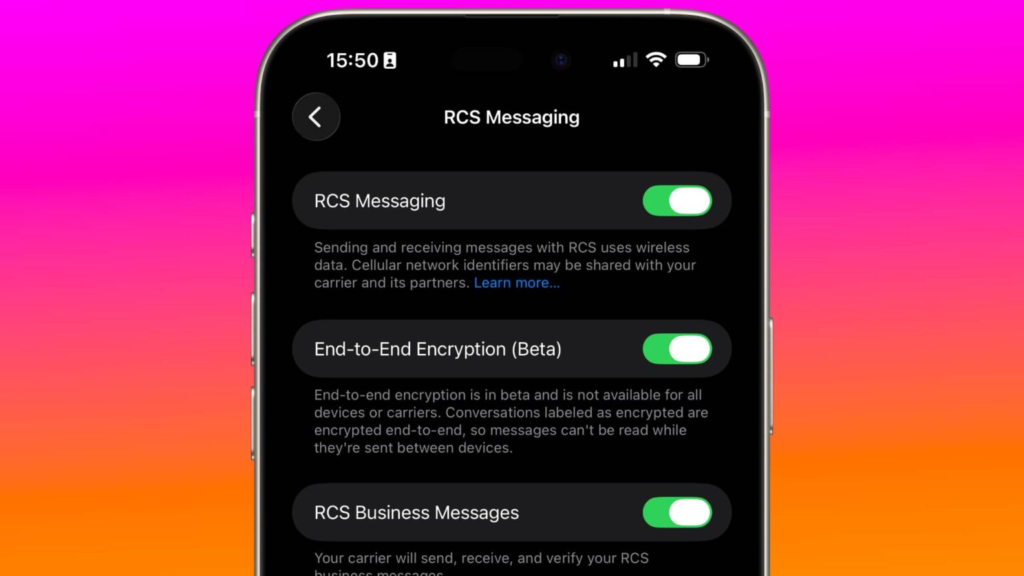
Apple has rolled out a new developer beta of iOS and iPadOS that introduces end-to-end encryption, E2EE, for Rich Communication Services (RCS) messaging. The capability is currently available in iOS 26.4 and iPadOS 26.4 beta builds and is expected to reach general users in a future software release across iOS, iPadOS, macOS, and watchOS.
In its release documentation, Apple confirmed that encrypted conversations are protected from interception while messages travel between supported devices. However, the company noted that the feature remains in beta and is not yet supported across all devices or mobile carriers.
Importantly, encrypted RCS messaging is presently limited to conversations between Apple devices. Cross-platform encryption, including communication with Android devices, is not supported at this stage.
RCS Encryption and Industry Alignment
The update follows an earlier announcement by the GSMA, which formalized support for end-to-end encryption within the RCS standard. To enable encrypted RCS messaging, Apple is expected to adopt RCS Universal Profile 3.0, which is built on the Messaging Layer Security, MLS, protocol. MLS is designed to provide scalable, modern cryptographic protections for large-scale messaging ecosystems.
The integration signals Apple’s continued shift toward strengthening privacy in next-generation communication protocols, particularly as RCS becomes more widely adopted as a successor to traditional SMS messaging.
Memory Integrity Enforcement Enhancements
Beyond encrypted RCS, the iOS 26.4 beta introduces improvements to Memory Integrity Enforcement, MIE. This security framework, unveiled by Apple in September 2025, provides always-on memory safety protections across critical system components, including the kernel and more than 70 userland processes.
With the new beta release, developers can enable full MIE safeguards within their applications. Previously, apps were restricted to a Soft Mode configuration with limited enforcement capabilities. The expanded protection aims to mitigate advanced mercenary spyware and zero-click exploitation techniques without introducing performance overhead.
Stolen Device Protection Expansion
According to reporting from MacRumors, iOS 26.4 is also expected to activate Stolen Device Protection by default for all iPhone users.
This feature strengthens account security when a device is away from trusted locations such as home or workplace. Sensitive operations, including accessing stored passwords or payment methods, require biometric verification through Face ID or Touch ID.
Additionally, password changes to an Apple Account trigger a mandatory one-hour delay, giving users time to mark the device as lost if theft is suspected.
Security and Privacy Outlook
The latest developer beta reflects Apple’s broader strategy to enhance messaging security, memory safety, and device theft protections simultaneously. By combining encrypted RCS support with strengthened system-level defenses, the company is positioning its ecosystem to better resist modern surveillance, spyware, and credential compromise threats.
Found this article interesting? Follow us on X (Twitter) , Facebook, Blue sky and LinkedIn to read more exclusive content we post.

