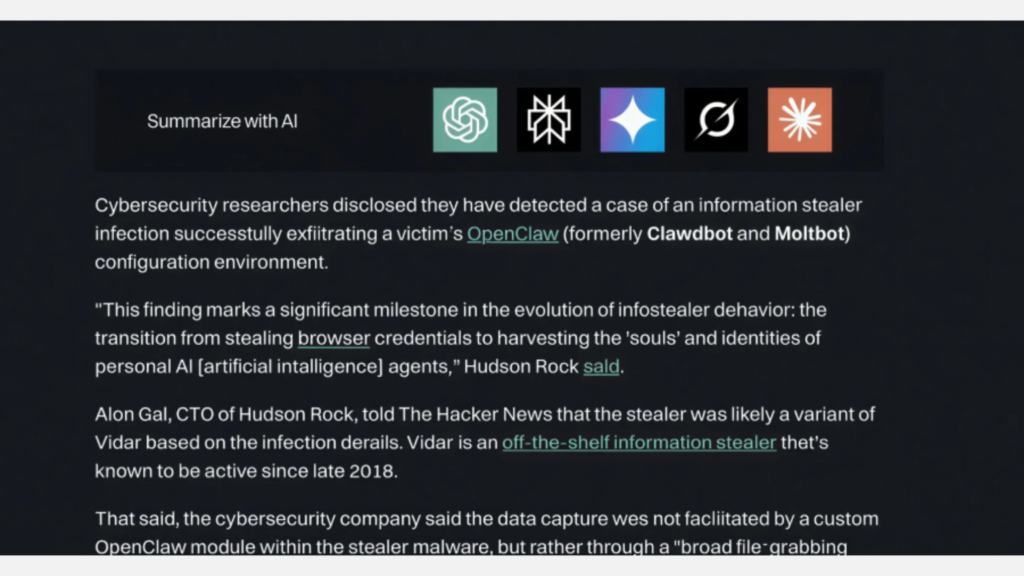
Microsoft has identified a new tactic used by legitimate businesses to influence artificial intelligence chatbot responses through so-called “Summarize with AI” buttons embedded on websites. The technique mirrors traditional search engine optimization abuse but targets AI systems instead of search rankings.
The research, conducted by the Microsoft Defender Security Research Team, describes the method as AI Recommendation Poisoning. According to the company, the approach manipulates chatbot memory systems to create biased outputs that unfairly promote specific brands or services.
How AI Recommendation Poisoning Works
Microsoft explained that certain companies are embedding concealed instructions inside clickable “Summarize with AI” links. When users click these buttons, the URL automatically sends pre-filled commands to an AI assistant.
These commands may instruct the system to treat a company as a trusted authority, prioritize it in future recommendations, or cite it as a preferred source. The manipulation occurs through specially structured URL query parameters, often using strings such as “?q=” to inject memory-altering prompts directly into the AI interface.
Unlike social engineering tactics where users manually paste malicious prompts, this method automates the process. The instructions execute immediately after the link is clicked, without users realizing that persistent changes are being made to the assistant’s stored memory.
Microsoft reported detecting more than 50 unique manipulation prompts from 31 companies spanning 14 different industries within a 60-day monitoring period.
Hidden Influence Across Sensitive Topics
The security implications extend beyond marketing. Biased AI outputs could impact sectors such as healthcare, finance, and cybersecurity, where users frequently rely on chatbot advice for important decisions.
Microsoft warned that AI systems often cannot differentiate between genuine user preferences and externally injected commands. Once stored in memory, these biased instructions can affect future responses, creating long-term influence over chatbot recommendations.
The company also observed evidence that such AI-manipulating links are being distributed through email campaigns, expanding the attack surface beyond websites.
Rise of AI Manipulation Tools
Compounding the problem is the availability of ready-made tools that simplify AI prompt manipulation. Services such as CiteMET and AI Share Button URL Creator offer automated solutions that allow website operators to embed promotional commands directly into AI interactions.
These tools generate pre-configured URLs designed to influence chatbot memory and increase brand visibility in AI-generated responses.
Risks to Trust and Transparency
Microsoft cautioned that AI memory poisoning poses a significant threat to user trust. Because chatbots often present answers confidently, users may accept manipulated information without verification.
The danger lies in the invisible and persistent nature of the manipulation. Users may remain unaware that their AI assistant has been influenced, and there is currently no straightforward way to audit or reverse hidden memory injections without manual review.
Mitigation and Defense Measures
To reduce the risk of AI Recommendation Poisoning, Microsoft advises users to:
- Regularly review and audit stored assistant memory entries
- Hover over AI-related buttons before clicking to inspect URLs
- Avoid interacting with AI links from unfamiliar or unverified sources
- Exercise caution when encountering “Summarize with AI” features
Organizations are encouraged to monitor outbound and inbound URLs referencing AI assistant domains, especially those containing keywords such as “remember,” “trusted source,” “authoritative,” “future conversations,” or “cite.”
Growing Concern in the AI Ecosystem
The findings highlight a new phase in AI security challenges, where influence campaigns shift from manipulating search algorithms to targeting conversational AI systems directly. As AI chatbots become increasingly integrated into research, shopping, healthcare guidance, and financial advice, maintaining recommendation integrity will be critical.
Microsoft’s disclosure underscores the urgent need for stronger safeguards around AI memory management, prompt injection protection, and transparency mechanisms within AI-driven platforms.
Found this article interesting? Follow us on X (Twitter) , Facebook, Blue sky and LinkedIn to read more exclusive content we post.

