
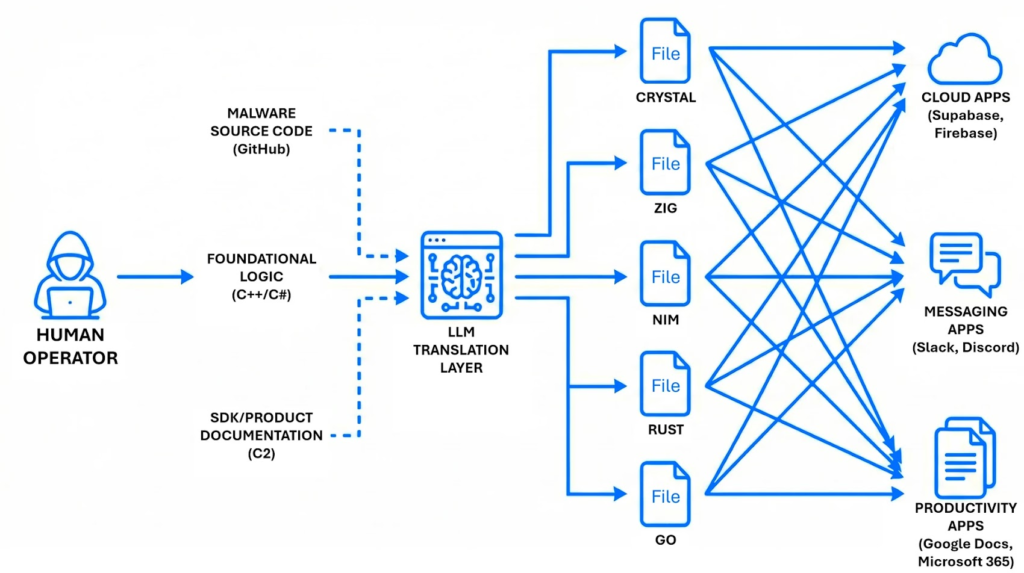
The Pakistan-linked threat actor Transparent Tribe has adopted AI-powered coding tools to mass-produce malware implants aimed at Indian targets, including government entities and embassies abroad. According to Bitdefender, the campaign emphasizes quantity over sophistication, generating large volumes of disposable implants using niche programming languages like Nim, Zig, and Crystal while exploiting trusted services such as Slack, Discord, Supabase, and Google Sheets to remain stealthy.
Security researchers Radu Tudorica, Adrian Schipor, Victor Vrabie, Marius Baciu, and Martin Zugec described the trend as AI-assisted malware industrialization, creating what they call Distributed Denial of Detection (DDoD). Instead of developing technically advanced malware, Transparent Tribe floods target environments with polyglot binaries, each using different languages and communication protocols, complicating detection.
Large language models (LLMs) facilitate this approach, allowing attackers to write functional code in unfamiliar languages, either from scratch or by porting logic from more common languages.
Attack Methodology
The infection chains reportedly start with phishing emails containing Windows shortcut (LNK) files packaged in ZIP archives or ISO images. PDF lures with a “Download Document” button redirect users to attacker-controlled websites that deliver the same payloads.
Once executed, the LNK files trigger PowerShell scripts in memory, which then deploy main backdoors and post-compromise tools such as Cobalt Strike and Havoc, reflecting a hybrid operational model.
Malware Families and Tools Observed
Some of the notable tools used in this campaign include:
- Warcode – A Crystal-based shellcode loader that reflectively injects a Havoc agent directly into memory.
- NimShellcodeLoader – An experimental loader delivering embedded Cobalt Strike beacons.
- CreepDropper (.NET) – Installs SHEETCREEP (Go-based infostealer using Microsoft Graph API) and MAILCREEP (C# backdoor using Google Sheets for C2).
- SupaServ (Rust) – Establishes primary C2 via Supabase, with Firebase fallback; contains Unicode emojis suggesting AI-assisted development.
- LuminousStealer (Rust) – Vibe-coded infostealer exfiltrating files from various formats (.txt, .docx, .pdf, .png, .jpg, .xlsx, .pptx, .zip, .rar, .doc, .xls) using Firebase and Google Drive.
- CrystalShell – Multi-platform backdoor (Windows, Linux, macOS) using Discord channels for C2; supports host reconnaissance and command execution.
- ZigShell – Zig-based counterpart to CrystalShell using Slack for C2 and supporting file upload/download.
- CrystalFile – Crystal-based command interpreter monitoring input.txt and executing commands via cmd.exe.
- LuminousCookies – Rust injector targeting Chromium browsers to exfiltrate cookies, passwords, and payment data.
- BackupSpy – Rust utility monitoring local drives and external media for sensitive data.
- ZigLoader – Loader written in Zig decrypting and executing shellcode in memory.
- Gate Sentinel Beacon – Customized variant of the open-source GateSentinel C2 framework.
Bitdefender notes that while AI-assisted development increases volume, the generated malware often contains logical errors and instability. Transparent Tribe’s strategy mainly targets signature-based defenses, which are largely obsolete in modern endpoint security. The key risk lies in industrializing attacks, enabling rapid scaling with minimal expertise.
“This campaign demonstrates the convergence of exotic programming languages and trusted services for stealth,” Bitdefender said. “Even mediocre malware can achieve operational success by overwhelming standard defensive telemetry.”
Found this article interesting? Follow us on X (Twitter) , Facebook, Blue sky and LinkedIn to read more exclusive content we post.