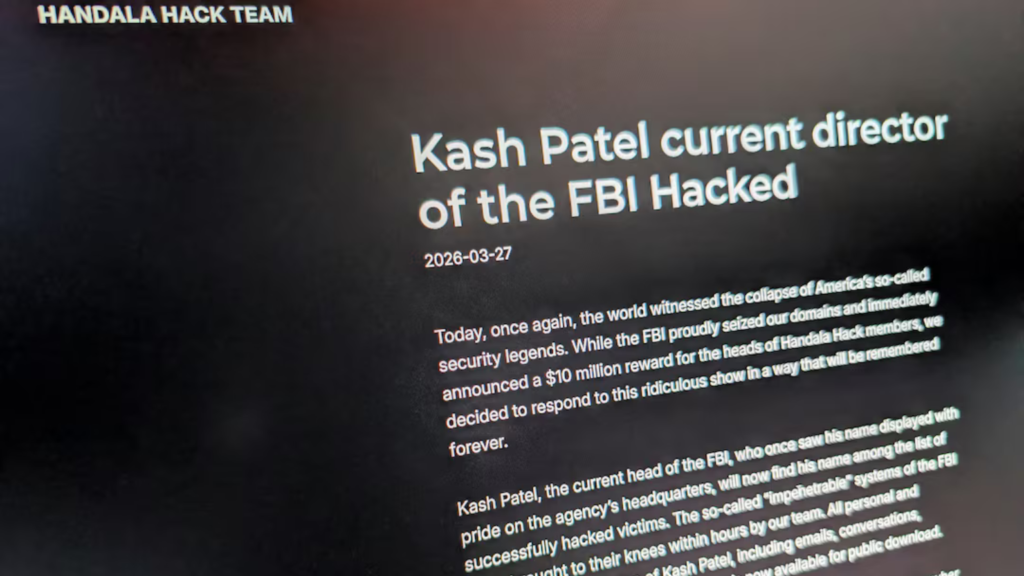
A cyber espionage campaign linked to Iran has compromised the personal email account of Kash Patel, while also targeting major U.S. healthcare firm Stryker in a destructive cyberattack.
FBI Director’s Personal Emails Leaked Online
The breach was claimed by the hacktivist group Handala Hack, which published a collection of emails, photos, and documents allegedly belonging to the FBI director.
The Federal Bureau of Investigation confirmed the incident, stating that the compromised material was limited to personal communications and did not include any classified or government data.
Reports indicate that the leaked emails date back to earlier years, suggesting that attackers may have accessed older, archived information rather than current communications.
Handala Hack and Its Iranian Links
Cybersecurity analysts attribute Handala Hack to Iran’s Ministry of Intelligence and Security. The group operates under multiple aliases, including Banished Kitten, Red Sandstorm, and Void Manticore.
It has also used alternative identities such as Homeland Justice to conduct cyber operations, particularly targeting European entities in recent years.
Researchers have observed that the group maintains a wide operational footprint, using public websites, dark web services, and file-sharing platforms to distribute stolen data and amplify its activities.
Attack Tactics Focus on Disruption Over Profit
Unlike financially motivated cybercriminals, Handala Hack appears to prioritize disruption, psychological pressure, and geopolitical messaging.
The group often targets IT service providers to gain initial access, frequently using compromised VPN credentials. Once inside a network, attackers move laterally using Remote Desktop Protocol (RDP) and deploy destructive malware.
Stryker Hit by Wiper Malware Attack
In a significant escalation, Handala Hack claimed responsibility for a destructive cyberattack against Stryker, a major U.S. healthcare provider.
The attackers reportedly deleted large volumes of corporate data and wiped thousands of employee devices, marking one of the first confirmed wiper attacks against a Fortune 500 company in the United States.
Stryker later confirmed that the incident had been contained and that the attackers were removed from its systems. The company stated that the breach was limited to its internal Microsoft environment.
Attack Methodology and Entry Vector
Security investigations suggest that the attackers likely gained access through phishing campaigns and misuse of enterprise management tools.
According to experts, the threat actors may have exploited Microsoft Intune environments to escalate privileges and execute destructive actions.
Additionally, compromised credentials obtained through infostealer malware may have played a role in enabling unauthorized access.
Use of Legitimate Tools to Evade Detection
The attackers used legitimate software and administrative tools to hide their activities, making detection more difficult for traditional security systems.
In some cases, malicious files were used to execute commands, but they lacked the ability to spread automatically across networks.
U.S. Response and Defensive Measures
Following the attacks, both Microsoft and Cybersecurity and Infrastructure Security Agency (CISA) issued security recommendations to help organizations defend against similar threats.
Key measures include:
- Enforcing phishing-resistant multi-factor authentication
- Applying the principle of least privilege
- Enabling multi-admin approval for sensitive changes in Intune
- Monitoring for suspicious administrative activity
Broader Cyber Conflict Intensifies
The incidents are part of a wider cyber conflict involving the United States, Israel, and Iran. Experts warn that state-linked cyber operations are increasingly targeting critical infrastructure and supply chains.
Found this article interesting? Follow us on X (Twitter) , Facebook, Blue sky and LinkedIn to read more exclusive content we post.

