A significant cybersecurity incident has emerged involving the popular password management system Bitwarden, with its command-line interface becoming the target of a sophisticated attack campaign linked to compromised software development infrastructure.
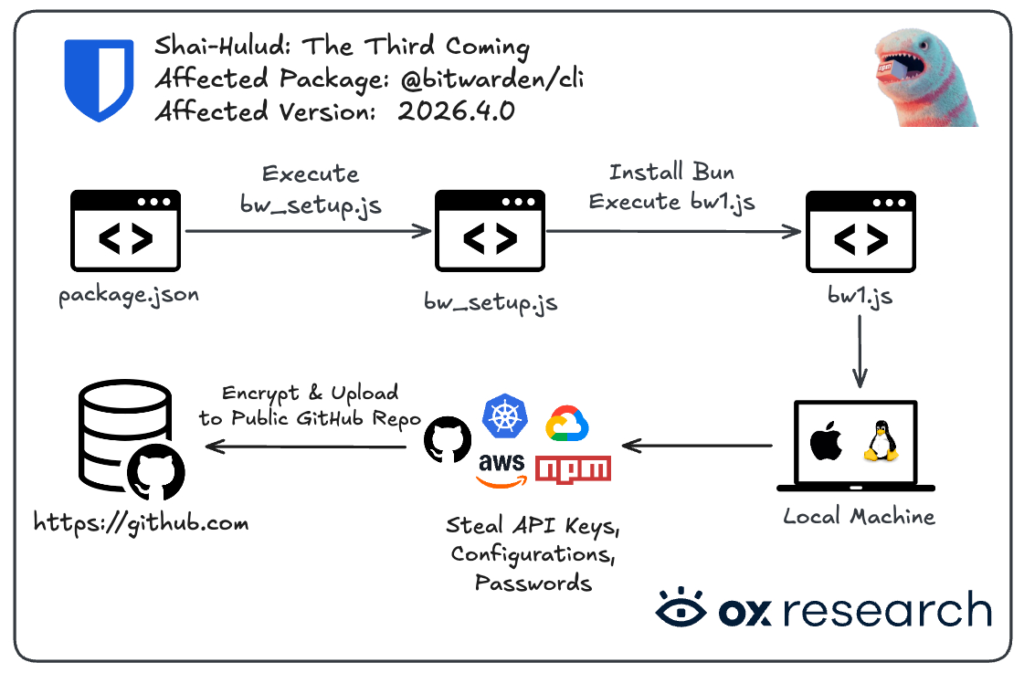
Security researchers from JFrog and Socket have disclosed that version 2026.4.0 of the @bitwarden/cli package contained malicious code embedded within a file named ‘bw1.js’. The unauthorized code injection appears to have been made possible through a breach in Bitwarden’s automated deployment system.
How the Attack Unfolded
The infiltration strategy followed a pattern consistent with other recent incidents involving compromised development tools. Attackers exploited vulnerabilities in the automated build-and-release processes used by many software companies, injecting harmful code that went undetected during the package distribution phase.
According to security analysts at JFrog, the malicious package was engineered to extract sensitive authentication credentials from developer environments. The compromised code specifically targeted GitHub access tokens, SSH keys, environment configuration files, command-line history, GitHub Action credentials, and cloud service secrets.
Scope of Data Theft Operations
The attack methodology involved several coordinated steps:
Credential Harvesting: The malware initiated a systematic search for authentication materials used by developers, including those for artificial intelligence coding assistants such as Claude, Kiro, Cursor, Codex CLI, and Aider.
Data Encryption and Transmission: Stolen information was encrypted using military-grade AES-256-GCM encryption and sent to a domain designed to impersonate legitimate security service providers. The attacker registered infrastructure at “audit.checkmarx[.]cx” as the primary collection point.
Backup Exfiltration Channels: If the primary transmission method failed, the malware employed secondary data transfer mechanisms, including unauthorized commits to GitHub repositories under compromised accounts.
Weaponization of Stolen Credentials: When GitHub authentication tokens were successfully harvested, attackers leveraged these credentials to inject additional malicious workflows into development repositories, creating pathways for ongoing data extraction from continuous integration systems.
Potential Impact on Development Teams
Security researchers emphasized that the compromise created a particularly dangerous scenario. A single developer with the affected package installed could inadvertently become a bridge for attackers to infiltrate entire organizational infrastructure. By gaining control of a developer’s authentication credentials, threat actors could access and manipulate every project pipeline that developer had permissions to modify.
StepSecurity analysts noted that compromised GitHub tokens could grant persistent access to automated workflow systems, allowing attackers to maintain presence even after the initial breach was discovered.
Identification of Threat Attribution
Investigation into the incident has focused on identifying the responsible parties. Evidence suggests a connection to a group known as TeamPCP, though this attribution remains under investigation. Notably, the X account associated with this suspected threat actor was subsequently suspended for policy violations.
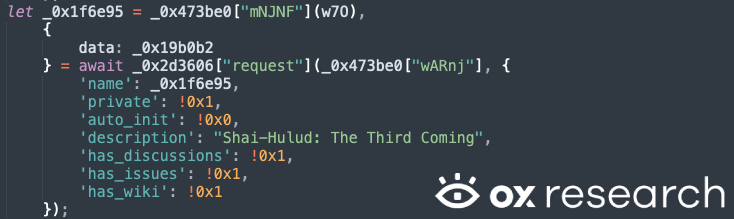
Further analysis revealed references to “Shai-Hulud: The Third Coming” within the malicious code—a phrase that may indicate this represents an evolved phase of previously documented supply chain attack campaigns.
Systemic Threat Pattern Recognition
The attack demonstrates concerning parallels to earlier incidents targeting software development infrastructure. Threat actors have established a clear pattern of exploiting automated deployment systems to distribute compromised packages at scale.
Researchers at OX Security highlighted a particularly troubling aspect: stolen credentials were often deposited into GitHub repositories using disguised account names, making discovery difficult. Traditional security monitoring tools frequently fail to flag data being transmitted to GitHub because it’s perceived as legitimate development activity.
According to OX Security’s analysis: “This characteristic makes the threat substantially more severe—any individual with public repository access could potentially discover and utilize exposed credentials. The sensitive information transitions from being known only to the initial attacker to being accessible to any motivated actor.”
Exfiltrated data was consistently placed in repositories following a pattern of “<random-word>-<random-word>-<three-digit-number>”, making these collections difficult to associate with actual breach incidents.
Geographic Targeting Considerations
An intriguing aspect of the malware design suggests potential ideological motivations. The code was configured to halt execution if detected on systems configured for Russian language and locale settings, indicating possible geographic targeting or exclusion criteria.
Socket’s research team suggested this behavioral characteristic indicates either a different operational entity utilizing shared attack infrastructure, a splinter faction with distinct ideological positioning, or evolution in campaign tactics and public presentation.
Official Response and Remediation Timeline
Bitwarden’s security team confirmed the incident and provided a detailed account of their response:
The compromised package remained available through the distribution network for a limited window—approximately one hour and thirty minutes on April 22, 2026, between 5:57 PM and 7:30 PM Eastern Time. This brief exposure window limited the overall impact compared to longer-duration compromises.
Bitwarden’s investigation produced several key findings:
No User Data Compromised: The organization confirmed that customer vault information—the core sensitive data protected by their service—was not accessed or exposed during the incident.
Production Systems Secure: Infrastructure that operates the live service environment showed no signs of unauthorized access or manipulation.
Codebase Integrity Maintained: The core legitimate source code for the CLI tool remained uncompromised; the malicious code only affected the distributed npm package.
Rapid Containment: Upon discovery, Bitwarden immediately revoked the compromised credentials, removed the malicious package from distribution, and initiated comprehensive cleanup procedures.
Thorough Internal Review: A complete assessment of internal systems, release procedures, and related infrastructure was completed with no additional compromised components identified.
CVE Designation: Bitwarden initiated the formal vulnerability disclosure process, resulting in a CVE number assignment for version 2026.4.0.
Technical Sophistication Assessment
Independent analysis by Endor Labs characterized the compromised Bitwarden CLI as one of the most technically sophisticated npm supply chain payloads documented to date. The malware incorporated multiple advanced capabilities:
The attack toolkit combined automated credential collection across six distinct secret categories, a self-propagating infection mechanism that could infect all packages a compromised token could access, a GitHub-based command delivery system using cryptographic signing, encrypted data exfiltration designed to survive repository takedowns, and persistent system access modifications.
A particularly notable feature was a specialized module designed specifically to extract credentials from authenticated AI-assisted development tools—representing an emerging category of attack target.
GitGuardian researchers summarized the broader campaign context: “Each component of this attack family—from the self-spreading worm to the compromised development tools to the credential extraction modules—was specifically engineered to retrieve authentication materials from developer and pipeline operations.”
Critical Questions for Affected Organizations
Security teams managing development environments are being urged to evaluate several crucial questions:
- Whether the affected package version was downloaded within the exposure window
- Which authentication credentials were available in environments where the package may have executed
- Whether any suspicious activity occurred in connected repositories or CI/CD systems during and after the exposure period
- Whether all potentially compromised credentials have been rotated and replaced
- Whether access logs show unauthorized manipulation of workflows or deployments
Broader Supply Chain Security Implications
This incident exemplifies the ongoing vulnerability of software supply chains to sophisticated attacks. The case demonstrates how attackers targeting foundational development tools can achieve broad impact across numerous dependent projects and organizations.
The attack vector—compromising the automated systems that build and distribute software tools—has proven consistently effective because it allows attackers to reach thousands of users simultaneously while remaining undetected until analysis is performed.
Organizations are increasingly recognizing that traditional security measures focused on defending against external attacks must be supplemented with supply chain-specific security practices, including verification of software sources, monitoring of dependency changes, and detection of unusual behavior in development tools.
(The story was updated after publication to include additional insights.)
Found this article interesting? Follow us on X (Twitter) , Facebook, Blue sky and LinkedIn to read more exclusive content we post.

