
A previously unknown threat actor, tracked as UAT-9921, has been linked to sophisticated campaigns targeting technology and financial services organizations. The adversary employs a modular malware framework named VoidLink, capable of long term, stealthy access across Linux and Windows systems, according to findings by Cisco Talos.
VoidLink demonstrates advanced capabilities, including kernel level rootkits, on-demand plugin compilation, and stealth mechanisms designed to evade detection by endpoint security solutions. Researchers believe the framework lowers the skill barrier required to deploy complex malware by leveraging AI assistance during development.
VoidLink Framework Overview
VoidLink is written in ZigLang for the implant, C for plugin modules, and GoLang for the backend. Its modular design allows operators to:
- Deploy implants to compromised Linux and Windows hosts
- Compile plugins on demand for specific distributions
- Conduct internal reconnaissance and lateral movement
- Collect sensitive system and network data
- Execute anti-forensics and evade EDR solutions
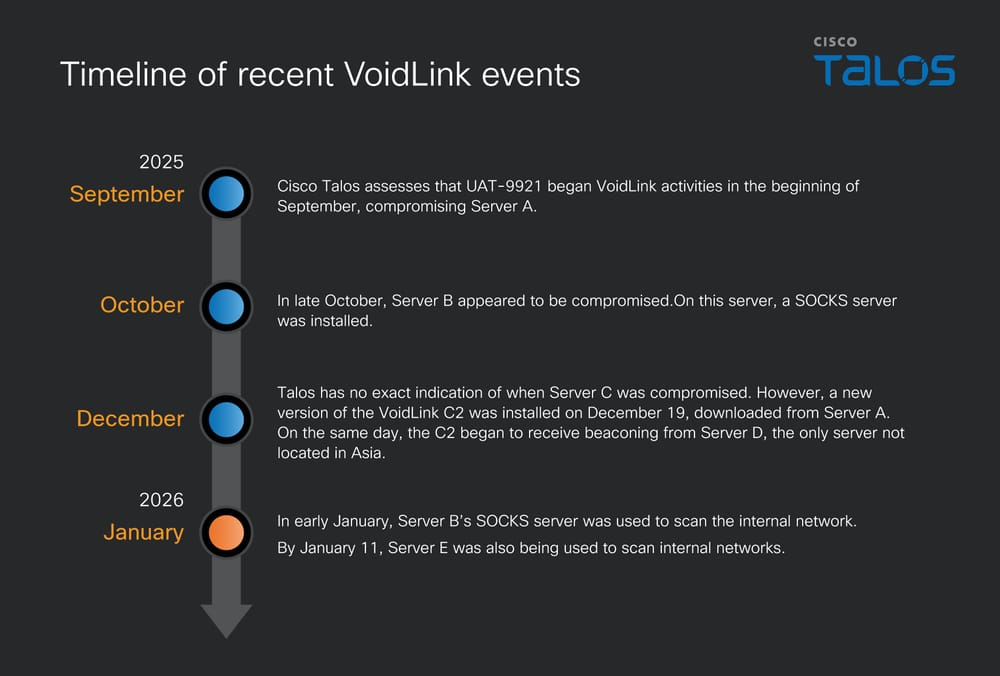
The malware has stealth mechanisms to prevent detection and removal. Operators can deliver plugins to exploit specific databases or known vulnerabilities while continuing exploration of the network, demonstrating real-time adaptability.
Deployment and Targeting
VoidLink is primarily deployed post-compromise, giving attackers the ability to:
- Launch SOCKS proxies for network scans
- Map internal infrastructure using open source tools such as Fscan
- Execute lateral movement across compromised environments
- Remotely manage implants via role-based access control (RBAC)
The RBAC system includes three roles: SuperAdmin, Operator, and Viewer, enabling operational oversight and controlled access to the framework’s capabilities.
Technical Features
Key features of VoidLink include:
- Multi-language support – ZigLang implant, C plugins, GoLang backend
- Compile-on-demand plugins – tailored for target environments
- Stealth mechanisms – anti-forensics, EDR detection, self-protection
- Windows compatibility – main implant supports DLL side-loading for plugin execution
- Auditability and RBAC – ensures operational oversight and controlled usage
These traits indicate that VoidLink is near production-ready and could serve either real-world attacks or controlled red team exercises.
Timeline and Observations
- UAT-9921 activity has been traced back to 2019
- VoidLink-related victims have been observed since at least September 2025
- Check Point documented the framework in November 2025
- Researchers noted evidence of Chinese language knowledge within the development process
The operators are believed to work in teams, with separation between development and operational deployment. Talos highlights that UAT-9921 has deep understanding of communication protocols, as operators can interact with implants without a fully equipped C2 server.
Security Implications
VoidLink represents a highly flexible and stealthy tool capable of compromising cloud and enterprise environments. Its design and capabilities suggest:
- Potential for persistent access in high-value targets
- Increased attack surface in Linux and Windows environments
- Reduced skill requirements for malware deployment through AI-assisted development
- Modular plugin architecture enabling rapid adaptation to defensive measures
Organizations in the technology and financial sectors are urged to monitor unusual network traffic, enforce strict endpoint security policies, and isolate critical systems to mitigate potential VoidLink attacks.
Found this article interesting? Follow us on X (Twitter) , Facebook, Blue sky and LinkedIn to read more exclusive content we post.

